|

6: Poor Mileage
"Normal" fuel mileage
normally varies somewhat depending upon a number of factors.
An average range for an FXD-series Harley is: 45-51 miles per
gallon at 65 mph on a flat road with no wind. The large touring
models typically deliver about five miles per gallon less. Fuel
mileage of less than 40 mpg at a steady 65 mph (flat road, no
wind) indicates a possible mechanical or tuning problem.
Common causes:
| Choke cable installation: |
An incorrectly installed choke
cable can lead to poor fuel mileage. |
| Carburetor tuning: |
An incorrectly jetted carburetor
can lead to both poor fuel mileage and performance. |
| Speed: |
Fuel consumption increases dramatically
with speed. |
| Head wind: |
Fuel consumption increases when
riding into the wind. |
| Weight: |
Motorcycles require more fuel when
climbing. |
| Size: |
Larger (touring) models create
more wind drag. |
| Engine efficiency: |
Highly developed engines use fuel
more efficiently. Poorly tuned ones do not. |
Choke cable installation:
There must be some free
play in the choke cable to ensure that the starter (choke) plunger
is fully closed. If the choke is held even slightly open, poor
mileage, sluggish performance and fouled spark plugs may result.
Harley
choke cable
If you are using the
Harley choke cable (the word ìChokeî on the knob
is white), use this procedure to determine if the choke is closing
completely:
- Pull the choke
knob out fully.
- Loosen the
friction nut just enough to allow the choke shaft to move freely.
The friction nut is located behind the choke knob. It is thin
and has ridges around its outer edge like a coin. If you turn
the friction nut out too far, it will interfere with your ability
to detect free play in the choke.
- Now, move
the choke knob in fully. Gently pull the knob out. There should
be a small amount of free play before you feel the tension of
the choke return spring.
If there
is no free play:
Check the routing of
the cable. The stock Harley cable is very stiff and tends to
bind in the metal elbow at the carburetor-end of the cable. The
end of the cable slips into the metal elbow and can jamb. The
joint (cable/elbow) is hidden by a rubber cover. Push the cable
end fully into the elbow.
- If this does
not cure the problem, it is possible that the choke cable assembly
was not assembled correctly. You must use the Mikuni choke
plunger and spring with the Harley choke cable. If you install
the complete Harley assembly (cable, plunger and spring), the
Harley plunger will not seal and the air/fuel mixture will be
very rich, especially at idle and low throttle settings.
Mikuni
choke cable:
The Mikuni choke cable is identified by the small brass bump
in the center of the knob. Mikuniís cable is much more
flexible that the stock Harley cable and seldom jambs. However,
it is possible that its length adjustment can be incorrect in
a particular installation.
- Check for free
play by gently pulling the knob. It should move freely for a
short distance before the force of the return spring is felt.
Even a slight amount of free play is enough.
- If there is
no free play, check the routing of the cable to make sure that
it is not kinked or pinched by other components. If necessary,
peel the rubber cover back and adjust the length of the cable
to introduce a small amount of free play.
Carburetor tuning:
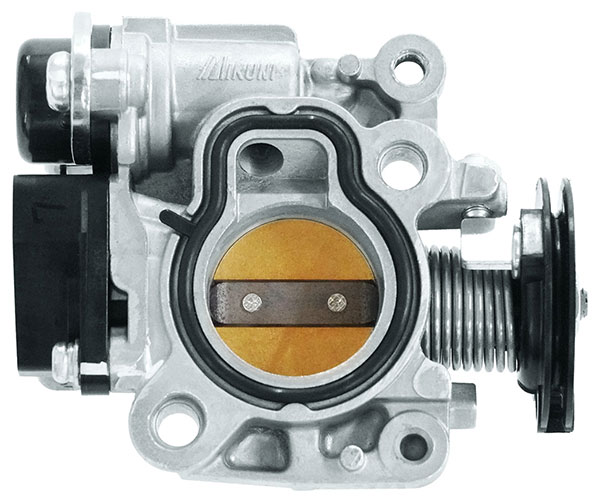
Mikuni HSR42/45/48 carburetors
are jetted to meet the requirements of the great majority of
engine tuning setups. The HSR-series is very tolerant of engine
tuning variations. However, it is certainly possible that minor
tuning adjustments may be desirable to achieve maximum performance
and/or maximum fuel economy with some engine component combinations.
Normal highway cruising speeds (65 mph/ 100 kph) require rather
low throttle openings, generally less than º throttle. Air/fuel
ratios in this throttle range are controlled by the pilot circuit
together with the jet needle and needle jet. Thus, poor fuel
economy at normal cruising speeds should be addressed by altering
or adjusting these parts.
Pilot
system:
The pilot circuit has
one replacable part and one adjustable part.The pilot jet is
replacable and the pilot air screw is adjustable. If the jet
is too large or the air screw is in too far, the air/fuel mixture
may be too rich. However, it is very unlikely that the pilot
jets installed at the Mikuni factory (#20 or #25) can cause a
dramatic loss of fuel economy. Some HSR45s are fitted with #35
pilot jets and these may be too rich for well-tuned engines.
See the tuning
manual elsewhere on this website.
Jet needle:
There are four different jet needles. Their part numbers are:
J8-8DDY01-95, -96, -97 and ñ98 (J8-8CFY02-xx for the 45
& 48). We commonly refer to them as a ìdash 97, dash
98, etc.î The current standard jet needle is a ì-97.î
The only difference between each needle is the diameter of the
straight part of the needle. This is the portion of the needle
that controls air/fuel mixture strengths between idle and approximately
º throttle. So, when a mixture change needs to be made in
this range, it is necessary to exchange jet needles. Raising
or lowering the needle has no effect on mixtures below º
throttle.
The jet needle is both adjustable and replacable. Its height
can be adjusted (via an ìEî clip and five grooves)
to change mixture strength between º and æ throttle.
Lowering the jet needle leans the mixture and raising it richens
the mixture.
Main jet:
The main jet becomes
the main fuel control at approximately 3/4 throttle. The main
jet has no effect on fuel mileage under any but the most extreme
riding conditions.
Speed:
Fuel consumption increases dramatically with speed. For instance:
If you wish to double the speed, your engine must produce approximately
eight times as much power. Thus, if 20 horsepower gets you 100
miles per hour, you'll need 160 HP to go 200. From this relationship
it is easy to understand why fuel economy drops so dramatically
between normal crusing speeds (65 - 75 miles per hour in America)
and higher speeds around or above 85 mph.
Head wind:
Fuel consumption increases when riding into the wind. If you
ride at 60 mph with a 20 mph headwind the fuel mileage is be
better than if you were going 80 mph with no head wind. However,
there is still a significant loss of fuel economy.
Weight:
Heavy motorcycles require
more fuel when climbing. This is simple to understand; the more
weight lifted, the more energy (fuel) needed to lift it. Thus,
a 20 percent heavier motorcycle requires about 20 percent more
fuel to climb a mountain at a given speed than the lighter machine.
An engine that has been modified to perform best in a higher-than-normal
rpm range may suffer a dramatic loss of fuel economy if it is
operated under load at an engine speed below its design minimum.
Size:
Larger (touring) models create more wind drag.
Engine efficiency:
Highly developed engines use fuel more efficiently. Poorly tuned
ones do not.
|